Supporting coaches. Strengthening organizations. Creating better experiences for kids and families.
Youth sports organizations invest heavily in programs, facilities, equipment, and competition. But the experience is ultimately delivered by the coach. WCA gives organizations the system to support and develop those coaches, create consistency across programs, and strengthen the overall coaching experience.
Youth sports organizations invest heavily in programs, facilities, equipment, and competition. But for a kid, the experience is ultimately shaped by the person standing on the field, court, or gym floor.
Coaches are asked to do a lot. They lead practices, build relationships, manage groups, communicate with families, create belonging, teach skills, and help kids grow.
Yet most organizations don't have a consistent system designed to support coaches in doing all of that well. Coaches are often trained once, handed a curriculum, and expected to figure out the rest as they go.
If the coach is central to the experience, the organization needs a system built around the coach.
The Solution
We Build the System Around the Coach
WCA creates the infrastructure around the coach: a repeatable system for recruiting, preparing, developing, supporting, and retaining the people who actually run your programs.
WCA isn't another coach training course. It's an organizational system that supports the coach before, during, and throughout the coaching experience.
You can have a great philosophy, a great curriculum, and a great program. If you don't have a system that supports the coach, none of it consistently reaches the kid.
WCA is designed to be adopted across programs, sports, and sites, creating a common coaching system without requiring every program to operate the same way.
Organization
↓
WCA Coach Operating System
↓
Coach
↓
Better Experience
↓
Kids, Families & Organization
How It Works
The WCA Coach Operating System
Four connected components, built to support the coach before, during, and after every practice.
Coach Development
Growth Built Into the Work
Coaches grow through the coaching they're already doing, not a separate course pulling them away from it.
Coaching System
Tools, Language & Practices
The tools, language, and practices coaches need to create a consistent experience across programs and seasons.
Organizational Support
Visibility for Leaders
Give leaders the tools and visibility to support coaches, strengthen implementation, and create consistency across programs and sites.
Measurement & Improvement
Evidence That Drives Change
Measure what matters, learn what is working, identify opportunities to improve, and continuously strengthen the system.
One system. Multiple sports. Multiple programs. One coaching standard.
One System. Built for Your Organization.
WCA Is Designed for Organizations Managing Youth Sports at Scale
WCA is designed for organizations managing youth sports across programs, sites, seasons, and sports, not for a single team or a single coach.
Parks & Recreation
Consistency across programs, facilities, and seasonal staff.
YMCAs
A common coaching standard across branches, sports, and communities.
School Districts
A stronger coaching experience across athletic and extracurricular programs.
Youth Organizations
A repeatable coaching system without rebuilding training from scratch every year.
Community Sports Organizations get better coaches and better experiences, without losing what makes their program local.
When organizations invest in the people delivering the experience, they create the conditions for stronger coaching, better participant experiences, and stronger retention.
More Consistent Coaching
One shared standard across programs, sites, and sports.
Better Coach Development
A real pathway to grow, not a one-time orientation.
Stronger Coach Retention
Create the conditions that help coaches feel prepared, supported, and connected to the organization.
Better Participant Experiences
Experiences kids actually want to come back to.
Greater Organizational Capacity
Systems that don't depend on one exceptional coach or director.
Scalable Implementation
A system built to move from one site to many.
We Integrate. We Don't Replace.
WCA Strengthens What You've Already Built
WCA doesn't ask you to rip out your leagues, your programs, your curriculum, your facilities, or your community relationships. We build around what already exists.
Your programs stay yours. Your community stays yours. Your identity stays yours. WCA strengthens the system around the coach.
Our Story
Where the Framework Began
The Whole Child Athletics Framework™ did not begin on a playing field. It began in a school district.
During nearly a decade of service on the Tacoma School Board, including several years as Board President, Scott Heinze was part of one of the most significant transformations in urban public education. Tacoma Public Schools became a national model for Whole Child, SEL-integrated education, achieving a historic 91.1% graduation rate and earning recognition from the Learning Policy Institute and the Aspen Institute.
What drove those outcomes wasn't a single program or a charismatic leader. It was a system aligned around the whole child, embedded across every classroom, and built to sustain results regardless of who was in the room.
The lesson was clear: when you design intentionally around the full development of a young person, including their academic growth, their emotional wellbeing, their sense of belonging, and their connection to community, outcomes follow. Not because of luck, but because the system was designed to produce them.
"What would happen if we applied the same systems thinking to youth sports?" — The question that Scott asked himself that built this framework
The Whole Child Athletics Framework™
Six Core Pillars
Belonging, participation, development, stewardship, wellness, and community are the foundation of the Whole Child Athletics™ Operating System. Inspired by the evidence behind the Whole Child movement, these six design principles guide how youth sports systems are built, led, and continuously improved.
1Belonging
Every student feels seen, connected, and valued.
Every young person deserves to feel seen, valued, connected, and accepted. Belonging is the foundation of participation, learning, confidence, and long-term engagement in sport. When athletes know they matter, they are more likely to stay involved, take healthy risks, and reach their potential.
We Believe
Every athlete deserves to feel they belong.
Relationships come before results.
Psychological safety fuels growth.
Every child should be known by name and valued as a person.
Success Looks Like
Athletes feel connected.
Positive team culture.
Inclusive environments.
Strong coach-athlete relationships.
2Participation
Multiple pathways exist beyond varsity athletics.
Every child deserves meaningful opportunities to play, regardless of ability, background, financial resources, or competitive aspirations. Healthy youth sports systems create multiple pathways for participation, not just varsity or elite competition.
We Believe
Access is a right, not a privilege.
Multiple pathways create lifelong participation.
Development happens through meaningful involvement.
Every athlete contributes.
Success Looks Like
Increased participation.
Higher retention.
Affordable access.
Multiple program options.
Reduced barriers.
3Development
Sports intentionally develop SEL, leadership, and life skills.
Sport is one of the most powerful classrooms a young person will ever enter. Athletic experiences should intentionally develop physical competence, social-emotional skills, leadership, resilience, character, and confidence alongside athletic ability.
We Believe
Winning is part of development, not the purpose of it.
Life skills can be intentionally taught.
Every practice is an opportunity to grow.
Success extends beyond athletic performance.
Success Looks Like
Confident athletes.
Resilient young people.
Leadership development.
Improved decision-making.
Lifelong love of physical activity.
4Stewardship
Coaches receive training, curriculum, and support to develop the whole athlete.
Exceptional youth sports programs don't happen by accident. They are created by adults who lead with purpose, professionalism, and accountability. Stewardship means equipping coaches, administrators, officials, and volunteers with the knowledge, systems, and support needed to consistently develop the whole athlete.
We Believe
Coaches shape lives.
Organizations are responsible for preparing coaches to succeed.
Systems create consistency.
Quality coaching should never depend on chance.
Success Looks Like
Certified coaches.
Consistent coaching standards.
Strong organizational leadership.
Sustainable systems.
Continuous improvement.
5Wellness
Physical activity supports mental, emotional, and social health.
Youth sports should improve physical, mental, emotional, and social well-being. The goal isn't simply producing better athletes, it's helping young people develop healthy habits and relationships with movement that last a lifetime.
We Believe
Physical activity supports whole-person health.
Joy is essential to long-term participation.
Healthy athletes perform better.
Wellness extends beyond fitness.
Success Looks Like
Increased physical activity.
Positive mental well-being.
Healthy habits.
Reduced burnout.
Lifelong engagement in movement.
6Community
Schools, parks, nonprofits, and families operate as aligned partners.
No single organization can create thriving youth sports alone. Schools, parks and recreation departments, healthcare providers, nonprofits, families, businesses, and community leaders each have a role to play. Lasting impact comes from aligned systems working toward shared outcomes.
We Believe
Collaboration creates opportunity.
Shared responsibility produces better outcomes.
Families are essential partners.
Communities thrive when young people thrive.
Success Looks Like
Strong partnerships.
Family engagement.
Shared investment.
Coordinated systems.
Greater community impact.
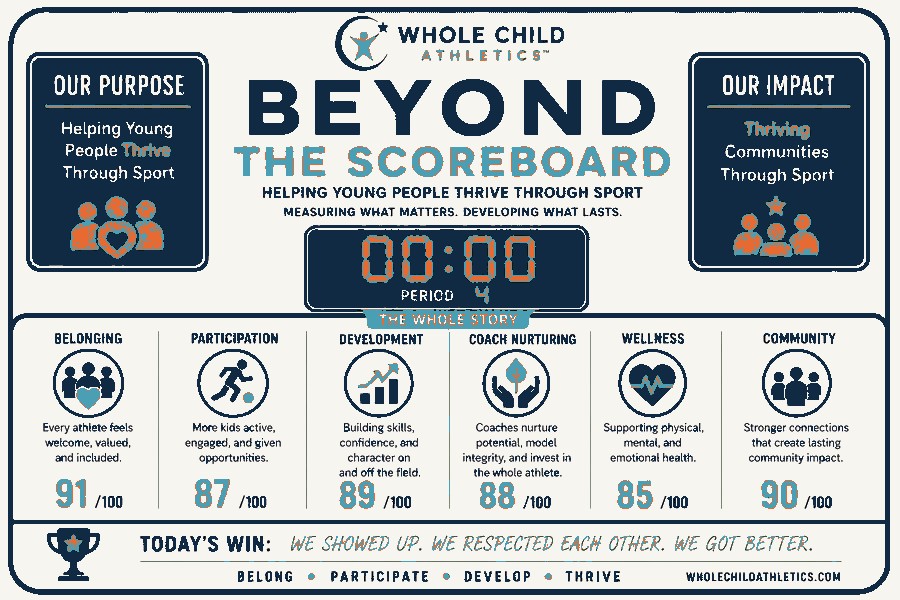
Beyond the Scoreboard™
What If We Kept Score Differently?
Winning matters, but it should never be the primary measure of success in youth sports.
At Whole Child Athletics,™ we believe sport is one of life's best classrooms and the greatest victories aren't found on the scoreboard, they're found Beyond the Scoreboard™ in the confidence, character, resilience, and belonging that young people carry with them long after the final whistle.
Every child deserves to hear three words:
You're an athlete.
Everyone plays. Everyone grows. Everyone belongs.
About
Built for Practitioners
Whole Child Athletics™ is led by Scott Heinze, former Tacoma School Board President, Aspen Institute Project Play partner, and youth sports systems designer. Scott brings the rare combination of elected governance experience, doctoral-level scholarship, and frontline coaching to every engagement. This framework is built for the practitioners, policymakers, and partners who believe access to sport is a right, not a privilege, and are ready to act on that belief.
Aspen Institute · Project Play
The Whole Child Athletics Framework™ is aligned with the Aspen Institute's Project Play initiative, the leading national effort to reimagine youth sports as a vehicle for lifelong health, development, and equity. The Whole Child Athletics Framework™ takes those principles and translates them into an actionable system design for practitioners on the ground to operationalize the findings from their State of Play report.
Scott Heinze served as a strategic advisor to Metro Parks Tacoma and to the Aspen Institute for the 2023 Tacoma-Pierce County State of Play report, a comprehensive assessment of youth sports access, participation trends, and system gaps across one of Washington State's most diverse regions.
What State of Play Tells Us
Participation drops sharply after age 11, steepest for low-income youth
Fragmented systems between schools, parks, and providers are the primary barrier
Aligned stakeholders see measurable gains in participation and health outcomes
Coaches and program quality determine whether kids keep playing
Methodology
Built on Systems, Not Individuals
Every engagement is grounded in a framework designed to produce outcomes that don't depend on any one person, site, or circumstance.
Predictable
1Consistent Delivery
Outcomes that can be achieved again and again, not dependent on individual talent or informal practices.
Defined operating model, not informal practices
Clear inputs, processes, and outputs
Performance consistent across sites and leaders
Replicable
2Standardized Frameworks
Implemented with fidelity across different environments, including schools, programs, and communities, without being rebuilt each time.
Standardized frameworks with local adaptability
Transferable across schools, programs, and communities
Clear implementation guidance and expectations
Scalable
3Built to Grow, Not Just to Start
A system that works for one site should work for fifty. Growth is planned into the model from day one, not bolted on after the fact.
Expansion doesn't dilute quality or outcomes
Staffing, training, and infrastructure scale together
New sites launch faster because the model already exists
Parents
Your Child Is More Than a Score.
Whole Child Athletics™ helps young athletes build confidence, belonging, leadership, healthy habits, and a love of playing—while developing the skills that matter on and off the field.
The WCA Parent Guide
6 Questions Every Parent Should Ask
Youth sports should help children become more confident, connected, resilient, and excited to keep playing. These are the six questions Whole Child Athletics™ believes matter most.
1
Is My Child Having Fun?
Fun isn't a bonus. It's the foundation. Does your child look forward to practices and games? Do they enjoy playing, learning, competing, and being with their teammates? When sports stop being enjoyable, participation becomes an obligation. And when participation becomes an obligation, kids eventually stop showing up.
Ask your child: "What is your favorite part of playing?"
2
Does My Child Want to Keep Playing?
The best sports experience creates a desire to come back. Does your child want to play again next season? Are they developing a positive relationship with movement, competition, teammates, and the game itself? Youth sports should help create lifelong participants, not simply short-term performers.
Ask your child: "Do you want to keep playing? Why or why not?"
3
Does My Child Feel Like They Belong?
Belonging comes before development. Does your child feel welcomed, included, valued, and accepted by their coaches and teammates? A child who feels like they belong is more likely to participate, take healthy risks, build relationships, and keep playing.
Ask your child: "Do you feel like you belong on this team?"
4
Is My Child Growing in Confidence?
Confidence is about more than performance. Is your child becoming more comfortable trying new things, making mistakes, speaking up, and believing in their ability to improve? A healthy sports environment should help children discover what they're capable of—not make them afraid of failure.
Ask your child: "What is something you feel more confident doing now than you did before?"
5
Is My Child Growing Through the Experience?
Development should be intentional. Is your child developing as an athlete and as a person? Are coaches providing feedback, encouragement, appropriate challenges, and opportunities to improve? Is your child learning to communicate, lead, work with others, handle adversity, and take responsibility? Your child shouldn't have to be the best player to receive a great sports experience.
Ask your child: "What are you getting better at—and what are you learning about yourself?"
Ask the coach: "How are you helping my child develop this season?"
6
What Is Being Measured, and How Is My Child's Growth as an Athlete and a Person Being Measured?
Growth Mindset Over Mastery of Skill
Is the program measuring more than points, playing time, wins, and losses? Does it have a clear methodology for understanding your child's athletic development, confidence, belonging, leadership, participation, wellness, and growth as a person?
Parents shouldn't have to guess whether their child's sports experience is making a difference. They should understand what is being measured, how it is being measured, and what the results mean.
Ask the coach or program: "What are you measuring, how are you measuring it, and how will I know my child is growing?"
Every child deserves a place to play.
Every child deserves a coach who sees their potential.
Every family deserves a great experience.
And every child deserves to hear three words:
YOU'RE AN ATHLETE!
Whole Child Athletics in the Conversation
In the Conversation
Scott Heinze regularly joins leaders, educators, and community voices to discuss how we can create youth sports experiences that develop the whole child.
Featured Conversation
A Playbook for Rebuilding Youth Sports
A conversation on why the current youth sports system pushes so many kids out by age 12, and what it actually looks like to rebuild it around belonging and long-term development.
A conversation with Tacoma Rising host Reid Fetters on what it takes to build youth sports systems that strengthen the South Sound community, not just the athletes in it.
We use cookies to understand site traffic and improve your experience. Accepting enables analytics and marketing cookies (via HubSpot). See our privacy policy for details.